Imagine this: An emergency happens in a lab late at night when no one is around. Responders hurry to the scene. But they are not sure about the research taking place in the lab. And they don’t know the ins and outs of the equipment, materials or potential hazards in the space.
Getting in touch with the right person quickly can help protect years of research and prevent the loss of valuable samples, ongoing experiments or specialized equipment that may be difficult, costly or even impossible to replace.
 If you are responsible for a campus lab, it’s imperative that you take a few minutes to verify your laboratory’s emergency contacts. In an emergency, that small action could help protect responders and preserve years of research.
It’s important to remember that the responder may not always be the fire department. Campus Facilities staff are often called for floods, water leaks, freezer alarms, electrical problems and ventilation failures. These events can quickly threaten laboratory safety, critical equipment and research materials.
Because incidents can occur at night, on weekends or during campus closures, an office telephone number may not be enough. Laboratory hazard communication signage should include an after-hours contact number — typically a cellphone number — for a knowledgeable person who can be reached when needed.
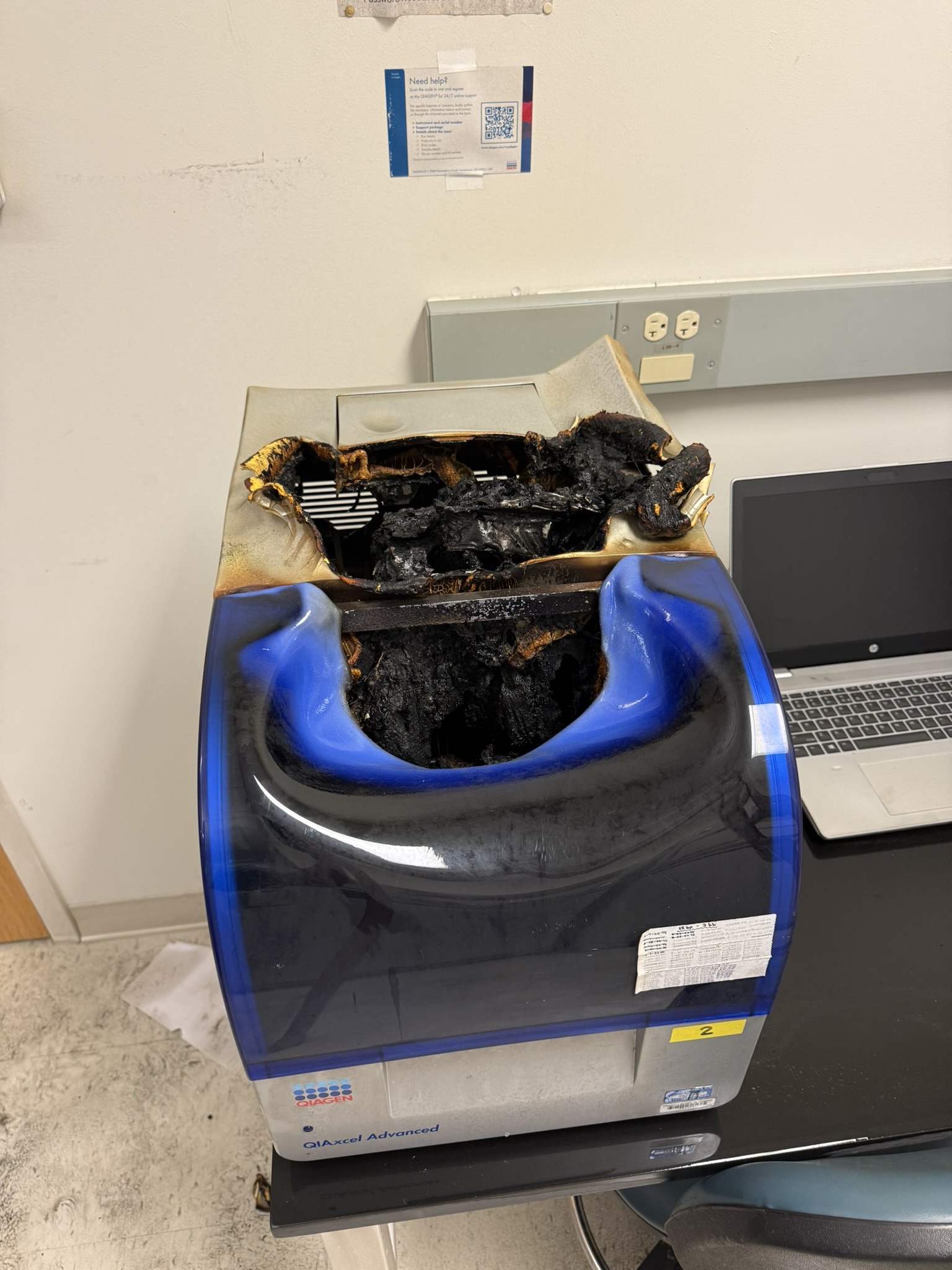
A recent research laboratory fire illustrates the importance of current contact information. The fire began in an electrophoresis machine following a minor power interruption. Because brief power interruptions are relatively common and can cause equipment to shut down, restart unexpectedly or malfunction, laboratories should check critical equipment afterward — particularly -80°C freezers, environmental chambers, incubators and other continuously operating systems.
Your hazard communication sign is the connection
Mizzou laboratory hazard communication signs identify the potential chemical, biological, radiological and physical hazards within a space. They also provide emergency contact information that connects firefighters, Campus Facilities employees and other response personnel with someone who understands what is hazardous, time-sensitive or irreplaceable.
A knowledgeable laboratory contact also can help responders determine whether critical samples or experiments are at risk, whether utilities can be safely shut down and whether equipment requires special handling. Timely information can protect responders while helping them minimize damage to research when conditions allow.
Take action today
Principal investigators, laboratory managers and lab workers should review the hazard communication signs posted at every entrance to their research spaces. Please confirm that:
Primary and alternate contacts are current.
At least one cellphone number can be reached after hours.
The listed contacts understand the laboratory’s hazards, equipment and critical research operations.
The hazards and required personal protective equipment shown on the sign are accurate.
Update and reprint the sign whenever contacts, telephone numbers, hazards, equipment or laboratory operations change.
Visit the Mizzou Environmental Health & Safety Hazard Communication Signs webpage for instructions on reviewing, updating, printing and posting laboratory signs. Questions may be directed to labsafety@missouri.edu.