| SOP Number: | EHS-SOP-RAD-302.00 |
| Effective Date: | 6/10/2026 |
| Latest Version By: | Liatris Parker-Reece, HP |
| Approved By: | Rachel Nichols, ARSO |
Purpose: The purpose of this SOP is to provide guidance on proper decontamination methods for skin, clothing, and minor wounds.
Scope: This procedure is intended for use by Radiation Workers responding to potential contamination incidents. It provides guidance on when Radiation Safety needs to be contacted, and when medical intervention is needed. Call 911 immediately before decontamination if medical attention is needed.
- Definitions:
- Contamination - “Unwanted radioactive material present on or in a person’s body, or unwanted radioactive material on an object.”
- Exposure – “Radiation received from a nearby radioactive source.”
- Minor Wound – “Shallow wounds that can be treated with an in-lab first aid kit. These wounds stop bleeding quickly and do not require medical attention.”
Major Wound – “Any wound (major cut, burn, puncture wound, etc) that requires more than first aid that a lab can provide and/or requires emergency care.
- Equipment Needed:
- Paper towels
- Decontamination solution (Radiacwash, Lift-Away, etc)
- Spill pads
- Plastic waste bags
- Corn meal (optional)
- Laundry detergent (optional)
Extra set of clothing or scrubs
Procedure Details:
Initial actions
- NOTE: If someone requires medical attention, call 911 immediately. Do not delay medical care for decontamination.
- Don gloves and eye protection.
- Take an initial dose rate survey (in mR/hr or cpm) of the contaminated person with an appropriate meter as described in Table 1.
Hold the probe approximately 1 cm above the surface of the skin and move the probe slowly over the area (5-8 cm per second).
Table 1. Appropriate meter types for contamination detection. Type of Radiation Types of Appropriate Meters Alpha Zinc-Sulfide probe, Geiger-Mueller with open faced probe Beta Geiger-Mueller with open faced probe or probe with beta window Gamma Geiger-Mueller with open faced probe, Sodium-Iodide probe Unknown Geiger-Mueller with open faced probe
- Survey the gloves before removing them.
- Dispose of gloves in a designated radiation waste bin.
- Survey hands and forearms to verify no contamination has transferred from the contaminated person to the person surveying.
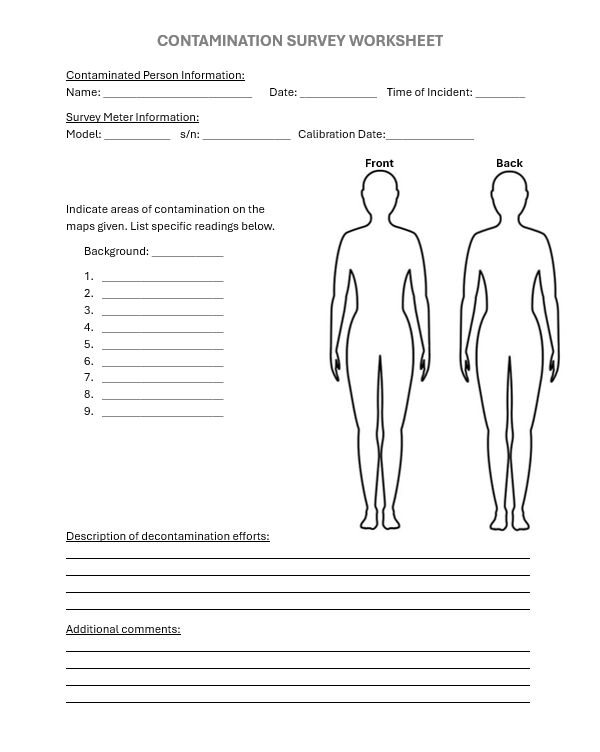
- Record the areas of contamination on the worksheet in Appendix A.
- Record the initial dose rate reading of the contamination and the background dose rate on the worksheet in Appendix A.
- Record the date and time of incident on the worksheet in Appendix A.Skin contamination with no wounds
Skin contamination with no wounds
For small areas of contaminated skin:
- Wash with soap and lukewarm water in a sink for at least one minute. Do not use abrasive brushes or rags that could damage or irritate the top layer of skin as this can increase the potential intake of radionuclides.
- Dry skin fully after washing it. Dispose of paper towels in a plastic waste bag or radioactive materials waste bin.
- Survey the skin again for contamination.
- If the area is still greater than 2x background, wash again in the sink. Stop if the skin starts to look irritated.
- If the area is <2x background, stop decontamination methods.
- Survey the person and verify that there are no other contaminated areas.
- Survey the general area and sink and verify that there is no contamination present.
- If contamination is discovered, decontaminate with soap and water or a decontaminant solution (Radiacwash, Lift-Away, etc).
- It is okay for contamination to go down the drain during personnel decontamination efforts.
- Send radiation safety a copy of Appendix A after decontamination methods have finished.
For large areas of contaminated skin:
- Have the contaminated person remove their contaminated clothing and step into an emergency shower. Individuals should use soap and lukewarm water for decontamination, not hot water.
- NOTE: make sure privacy is available for the person using the emergency shower. This can be done by hanging curtains or privacy screens in the area. Remove all non-contaminated and non-essential personnel from the area.
- After the emergency shower, have the person dry off fully and then have them survey their body for contamination.
- If the dose rate is <2x background, stop decontamination methods. Contact Radiation Safety and inform them of the incident.
- Provide the person with non-contaminated clothing or scrubs.
- If the dose rate is still ≥2x background:
- If on hand, use a mixture of half corn meal and half laundry detergent to clean areas of contaminated skin.
- If dose rate is still high after a second decontamination attempt, contact Radiation Safety for assistance.
- Send Radiation Safety a copy of Appendix A after decontamination methods have finished.
- Have the contaminated person remove their contaminated clothing and step into an emergency shower. Individuals should use soap and lukewarm water for decontamination, not hot water.
For hair contamination:
- Wash hair in a sink with soap and water.
- If the dose rate is ≥2x background after washing:
- Clip the contaminated hair using scissors and dispose of the hair with other contaminated materials. Do not shave the hair, this can cause abrasion of the skin barrier.
- Send radiation safety a copy of Appendix A after decontamination methods have finished.
Eye contamination
- Rinse out eyes in eyewash station for at least 15 minutes.
- Contact Radiation Safety as soon as possible.
- If possible, take a dose rate reading after the eyes have been washed for 15 minutes.
- If there is a detectable reading after 15 minutes of washing, medical intervention may be required for more aggressive decontamination methods.
- Send radiation safety a copy of Appendix A after decontamination methods have finished.
Clothing contamination
If it is an outer layer of clothing (such as a jacket):
- Don gloves.
- Remove the piece of clothing and place it in a box or thick plastic bag.
- Seal the box or bag.
- Survey the area around where the contamination occurred and verify that there is no more contamination.
- Send radiation safety a copy of Appendix A after decontamination methods have finished.
If it is a base layer of clothing:
- Don gloves.
- Remove the piece of clothing or cut away the contaminated part of the clothing with sheers.
- When clothing needs to be removed, take the person to a private area if possible and find them a replacement piece of clothing or scrubs.
- Do not delay decontamination methods if a private area is not readily available.
- When clothing needs to be removed, take the person to a private area if possible and find them a replacement piece of clothing or scrubs.
- Survey each area that a contaminated person was in to verify that no contamination was tracked during relocation.
- If contamination was tracked, decontaminate these areas using soap and water or another decontaminant solution (Radiacwash, Lift-Away, etc).
- Make sure that the piece of contaminated clothing does not touch anything else while it is being removed.
- Place the contaminated piece of clothing in a box or thick plastic bag.
- Seal the box or bag.
- Survey the skin that was in contact with the clothing to verify that it is not contaminated.
- If part of the skin is contaminated, reference step 5.b. of this SOP for decontamination methods.
- Survey the rest of the clothing and exposed skin to verify that no more contamination remains.
- Survey the surrounding area where the contamination occurred and verify that there are no other areas of contamination.
- Collect any bags or bins containing contaminated material and properly label it according to MU Environmental Health & Safety waste standards.
- A description of how to properly label and package waste can be found in EHS-SOP-RAD-800.00.
- Send Radiation Safety a copy of Appendix A after decontamination methods have finished. Radiation Safety will follow up with any additional corrective actions that need to be taken.
Minor wound contamination
- Survey the wound. Record the dose rate (mR/hr or cpm) on the worksheet in Appendix A.
- Even if there is no elevated dose rate, still perform the next steps of this procedure.
- Run the wound under lukewarm water.
- Promote bleeding by expressing the wound. This will help remove potential contamination inside the wound.
- Survey the wound again.
- If dose rate is <2x background, stop decontamination methods and bandage the wound.
- Contact Radiation Safety with a description of the incident and for any follow-up actions.
- If dose rate is still ≥2x background:
- Contact Radiation Safety immediately.
- Medical intervention may be required depending on the amount of radioactive material absorbed in the wound.
- Survey the wound. Record the dose rate (mR/hr or cpm) on the worksheet in Appendix A.
Major wound contamination
- For major wounds or suspected major internal contamination, call 911 immediately.
- Do not delay medical care even if someone is believed to be contaminated.
- Reference the campus emergency instructions regarding actions to take if the injury occurs in conjunction with a larger accident.
- After 911 is contacted, immediately contact EHS Radiation Safety.
- If the person is alert and moving, ask them to move away from the contaminated area.
- If they are unconscious or impaired, do not attempt to move them. Wait for first responders to arrive.
- If possible, have someone decontaminate any potentially contaminated surfaces in the area so that first responders can access the injured person easier.
- Survey all other people who were present for the incident and verify that no other personnel are contaminated.
- If there are other people contaminated, decontaminate them according to the relevant section of this SOP.
- Radiation Safety will coordinate with the hospital regarding care of contaminated patients.
- For major wounds or suspected major internal contamination, call 911 immediately.
Inhalation or ingestion of radioactive materials
- If radioactive materials are believed to have been ingested or inhaled, contact Radiation Safety and provide the following information:
- Amount of radioactive material believed to have been ingested/inhaled
- How many people were affected
- If there are any other injuries (call 911 immediately if there is an injury requiring medical treatment)
- If inhalation occurred:
- Use a Q-tip, swab, or cloth to lightly swipe the inside of the affected person’s nostrils.
- Store this in a plastic bag or other form of containment for Radiation Safety.
- This swab can be used to estimate the amount of radioactive material inhaled.
- Medical intervention may be necessary depending on amount and type of radionuclide(s) inhaled.
- If ingestion occurred:
- Do not induce vomiting unless instructed to do so.
- Medical intervention may be necessary depending on amount and type of radionuclide(s) ingested.
- If radioactive materials are believed to have been ingested or inhaled, contact Radiation Safety and provide the following information:
Follow-up regarding contamination incidents
- Radiation Safety will perform a dose evaluation to determine if medical attention is required, or if any reporting requirements to regulatory agencies are met.
- A description of reportable incidents can be found in EHS-SOP-RAD-301.00.
- Additional corrective actions may be initiated to prevent a reoccurrence of the incident in the future.
- Radiation Safety will perform a dose evaluation to determine if medical attention is required, or if any reporting requirements to regulatory agencies are met.
- References:
- “Management of Persons Contaminated with Radionuclides: Handbook”, National Council on Radiation Protection and Measurements, Report No. 161, Dec. 2008.
- “Development of a Biokinetic Model for Radionuclide-Contaminated Wounds and Procedures for Their Assessment, Dosimetry and Treatment”, National Council on Radiation Protection and Measurements, Report No. 156, Dec. 2006.
S. Sugarman, “Early Internal and External Dose Magnitude Estimation”, The Radiation Emergency Assistance Center/Training Site, July 2017.
- Revisions:
- Rev 00 – 2026-06-10 – New SOP
- Rev 00 – 2026-06-10 – New SOP
Appendix A
Link to printable pdf version of worksheet