Laser Permits
All lasers in classes 3R, 3B, and 4 are required to registered with Environmental Health & Safety (EHS) under a laser permit. Laser classes 1, 1M, 2, and 2M do not need to be registered.
To register a laser with EHS, the following information is needed:
- Make and model
- Serial number
- Laser class
- Laser type (CO2, Dye, Argon, etc)
- Pulsed or continuous operation
- Emission wavelength
- Energy output
- Fixed or mobile
- Building location
- Department or person laser is owned by
If a department or PI is already issued a laser permit, a new laser (Classes 3R, 3B, and 4) can be added to the permit. For a department or PI without a laser permit, an application will need to be submitted. A guide on how to submit an application for a laser permit can be found here.
If a laser permit needs to be transferred to another PI on campus, email Radiation Safety at rad@missouri.edu for assistance.
Laser Class Requirements
Classes 1 and 1M
Class 1 lasers and laser systems are considered to be incapable of producing damaging radiation levels, and are, therefore, exempt from most forms of surveillance.
Classes 2 and 2M
Class 2 lasers and laser systems are visible light spectrum (0.4 to 0.7 um) continuous wave (CW) and repetitive-pulse lasers and laser systems which can emit accessible radiant energy exceeding the appropriate Class 1 Accessible Emission Limit (AEL) for the maximum duration inherent in the design or intended use of the laser or laser system, but not exceeding the Class 1 AEL for any applicable pulse (emission) duration < 0.25 seconds and not exceeding an average radiant power of 1mW.
Class 2 lasers may be viewed directly under carefully controlled exposure conditions. These lasers are considered safe because the natural reflex of the eye will prevent average exposure from causing damage.
Class 3R
Class 3R lasers and laser systems include lasers and laser systems which have an accessible output between 1 and 5 times the Class 1 AEL for wavelengths shorter than 0.4 µm or longer than 0.7 µm (non-visible light spectrum), or less than 5 times the Class 2 AEL for wavelengths between 0.4 and 0.7 µm (visible light spectrum).
Class 3R lasers will normally not produce injury if viewed only momentarily by the unaided eye. The Class 3R lasers may be a hazard if viewed using optics, e.g., telescopes, microscopes, or binoculars.
Requirements for operating Class 3R lasers:
- A Laser Warning Sign should be posted.
- Appropriate warning labels shall be posted.
- The beam path should be enclosed as much as possible to prevent an individual from placing their extremities, head, or reflecting objects into the beam path.
- The laser system shall only be used under the supervision of a responsible person who is familiar with the potential hazards of the laser.
- Users or operators of Class 3R laser systems should complete EHS Laser Safety training before first operation of the laser.
Class 3B
Class 3B lasers and laser systems include:
- Ultraviolet (0.18 to 0.4 µm) and infrared (1.4 µm to 1 mm) lasers and laser
systems which can emit during any emission duration within the maximum duration inherent in the design of the laser or laser system, but which (a) cannot emit an average radiant power in excess of 0.5 W for ≥ 0.25 seconds or (b) cannot produce a radiant energy greater than 0.125 Joules within an exposure time < 0.25 seconds. - Visible (0.4 to 0.7 µm) or near-infrared (0.7 to 1.4 µm) lasers or laser systems which emit in excess of the AEL of Class 3R but which (a) cannot emit an average radiant power in excess of 0.5 W for ≥ 0.25 seconds and (b) cannot produce a radiant energy greater than 0.03 Joules per pulse.
Class 3B lasers may cause severe eye injuries through direct or specular exposure. Examples: continuous lasers not exceeding 0.5 watts for any period greater than 0.25 seconds, pulsed visible lasers not emitting more than 0.03 joules per pulse, pulsed infrared or ultraviolet lasers not emitting more than 0.125 joules during any period less than 0.25 seconds.
Requirements for operating a Class 3B laser:
- A Laser Warning Sign and appropriate warning labels shall be posted.
- The beam path should be enclosed as much as possible to prevent an individual from placing their extremities, head, or reflecting objects into the beam path.
- The laser system shall only be used under the supervision of a responsible person who is familiar with the potential hazards of the laser.
- Protective housings which enclose the laser shall be provided with an interlock system which is activated when the protective housing is opened or removed during operation and maintenance to de-energize the laser.
- Fail-safe interlocks shall be provided for any portion of the protective housing which, by design, can be removed or displaced during operation and maintenance.
- Portions of the protective housing that are only intended to be removed from any laser or laser system by the service personnel, which then permits direct access to laser radiation shall either:
- be interlocked; or
- require a tool for removal and shall have an appropriate warning label on the panel.
- If the interlock can be bypassed or defeated, a warning label with the appropriate indications shall be located on the protective housing near the interlock.
- A Class 3B laser or laser system should be provided with a master switch that can effect beam termination and/or system shutoff. The master switch should be operated by a key or by a coded access.
- A Class 3B laser or laser system should be provided with a permanently attached beam stop or attenuator.
- Class 3B lasers shall be operated in a controlled area.
- If the laser is not fully enclosed, laser operation should be in a light-tight room with interlocked entrances to assure that the laser will shut off when the door is opened.
- Laser use and alignment SOPs should be written for Class 3B lasers.
- For Class 3B lasers, a warning light or buzzer should indicate laser operation.
- Users or operators of Class 3B laser systems shall complete EHS Laser Safety training before first operation of the laser.
Class 4
Class 4 lasers and laser systems are those that emit radiation that exceeds the Class 3B AEL. Class 4 lasers are a hazard to the eye from the direct beam, specular reflections, and sometimes even from diffuse reflections. Class 4 lasers can also start fires
and can cause thermal injuries to skin. Class 4 lasers usually have enough irradiance to produce LGAC’s and collateral radiation hazards, e.g. plasma, and blue light. Example: lasers operating at power levels greater than 0.5 watts for
continuous wave lasers or greater than 0.03 Joules for a pulsed system.
Requirements for operating a Class 4 laser:
- Protective housings which enclose the laser shall be provided with an interlock system which is activated when the protective housing is opened or removed during operation and maintenance to de-energize the laser.
- Fail-safe interlocks shall be provided for any portion of the protective housing which, by design, can be removed or displaced during operation and maintenance.
- Portions of the protective housing that are only intended to be removed from any laser or laser system by the service personnel, which then permits direct access to laser radiation shall either:
- be interlocked; or
- require a tool for removal and shall have an appropriate warning label on the panel.
- If the interlock can be bypassed or defeated, a warning label with the appropriate indications shall be located on the protective housing near the interlock.
- A Class 4 laser or laser system shall be provided with a master switch that can effect beam termination and/or system shutoff. The master switch shall be operated by a key or by a coded access.
- A Class 4 laser or laser system shall be provided with a permanently attached beam stop or attenuator.
- Class 4 lasers shall be operated in a controlled area, where all entryway safety controls shall be designed to allow both rapid egress by laser personnel at all times and admittance to the laser controlled area under emergency conditions.
- If the laser is not fully enclosed, laser operation shall be in a light-tight room with interlocked entrances to assure that the laser will shut off when the door is opened.
- Class 4 lasers or laser systems should be controlled and monitored at a position as far as possible from the emission portal of the laser or laser system.
- Laser use and alignment SOPs shall be written for Class 4 lasers.
- For Class 4 lasers, a warning light or buzzer shall indicate laser operation.
- Users or operators of Class 4 laser systems shall complete EHS Laser Safety training before first operation of the laser.
Laser Posting Requirements
Signage for Classes 2 and 2M Lasers
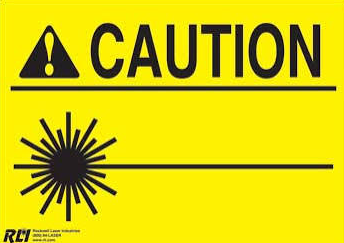
For Classes 2 and 2M lasers, a caution sign should be used. An example of a laser caution sign is shown below. This signage should either be posted on the door to the room containing the laser and on a conspicuous place on the laser housing or control panel. Write the class of laser on the bottom right-hand corner of the sign.
Signage for Classes 3R, 3B, and 4 Lasers
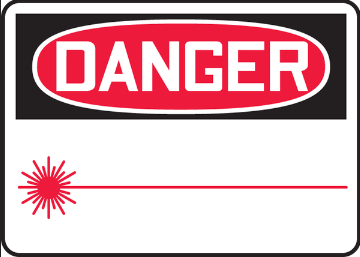
For Classes 3R, 3B, and 4 lasers, a danger sign should be used. An example of a laser danger sign is below.
Sign information and warnings shall conform to the following specifications:
- Above the tail of the sunburst, write special precautionary instructions or protective action that may be applicable. For example:
- Laser Protective Eyewear Required
- Invisible Laser Radiation
- Knock Before Entering
- Do Not Enter When Light is On
- Restricted Area
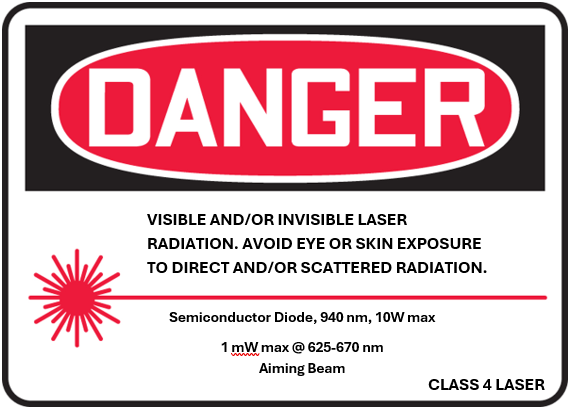
- Below the tail of the sunburst, write the type of laser (i.e. Nd:YAG, Helium-Neon, etc), or the emitted wavelength, pulse duration (if appropriate), and the maximum output.
- In the bottom right-hand corner of the warning sign, the class of laser or laser system shall be written.
An example of a properly filled completed laser danger sign is shown below.
Personal Protective Equipment Requirements
Due to the risk of eye injury when utilizing Class 3B and Class 4 lasers, wearing laser protective eyewear is necessary when working with these lasers. Laser protective eyewear may include goggles, face shields, spectaclees, or prescription eyewear using special filter materials and/or reflective coatings to reduce the potential ocular exposure below the applicable Maximum Permissible Exposure level.
Eyewear shall meet the following requirements:
- Protective eyewear shall be used only at the wavelength and energy/power for which it is intended.
- Label the protective eyewear with the laser type and/or light wavelength that the eyewear is designed for.
- Keep protective eyewear in good condition and always replace damaged or defective eyewear.
Additional considerations for protective eyewear:
- Protective eyewear for lasers is specialized for specific wavelengths and optical densities.
- Protective eyewear rated for a certain wavelength and optical density CANNOT be used for another wavelength and optical density. Using the incorrectly rated eyewear can result in eye damage.
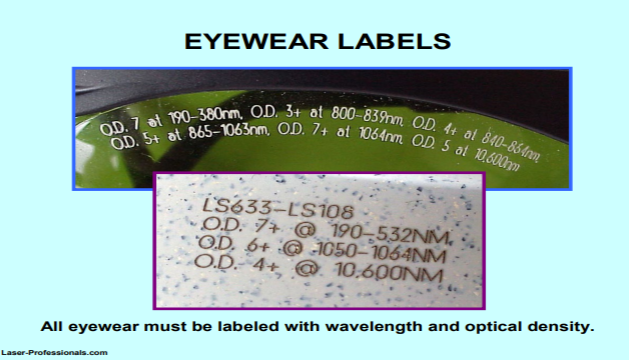
- The wavelengths and optical densities the eyewear is rated for should be printed on the protective equipment itself.
Verify that you are using the correct eyewear before operating the laser.
- If a laser system can produce multiple wavelengths or if there are multiple lasers in one lab, make sure that all protective eyewear is correctly labeled and kept separated. This is to ensure that there are no accidents where the wrong protective eyewear is used.
- All personnel working in labs with multiple lasers should be trained to always verify eyewear ratings before laser operation.
| Q-Switched Laser (10-9 - 10-2 s) | Non-Q-Switched Lasers (0.4 x 10⁻³ - 10-2 s) | Continuous Wave Lasers Momentary (0.25 - 10 s) | Continuous Wave Lasers Long-Term Staring (< 1 hr) |
Attenuation | |||||
|---|---|---|---|---|---|---|---|---|---|
| Maximum Output Energy (J) | Max Beam Radiation Exposure (J*cm-2) | Max Laser Output Energy (J) | Max Beam Radiant Exposure (J*cm-2) | Max Power Output (W) | Max Beam Irradiance (W*cm^-2) | Max Power Output (W) | Max Beam Irradiance (W*cm-2) | Attenuation Factor | OD |
| 10 | 20 | 100 | 200 | 105 | 2 x 10⁵ | 100 | 200 | 108 | 8 |
| 1 | 2 | 10 | 20 | 104 | 2 x 10⁴ | 10 | 20 | 107 | 7 |
| 10-1 | 2 x 10⁻¹ | 1 | 2 | 103 | 2 x 10³ | 1 | 2 | 106 | 6 |
| 10-2 | 2 x 10⁻² | 10-1 | 2 x 10⁻¹ | 100 | 200 | 10-1 | 2 x 10⁻¹ | 105 | 5 |
| 10-3 | 2 x 10⁻³ | 10-2 | 2 x 10⁻² | 10 | 20 | 10-2 | 2 x 10⁻² | 104 | 4 |
| 10-4 | 2 x 10⁻⁴ | 10-3 | 2 x 10⁻³ | 1 | 2 | 10-3 | 2 x 10⁻³ | 103 | 3 |
| 10-5 | 2 x 10⁻⁵ | 10-4 | 2 x 10⁻⁴ | 10-1 | 2 x 10⁻¹ | 10-4 | 2 x 10⁻⁴ | 102 | 2 |
| 10-6 | 2 x 10- | 10-5 | 2 x 10⁻⁵ | 10-2 | 2 x 10⁻² | 10-5 | 2 x 10⁻⁵ | 10 | 1 |
Laser Inspections
Class 3B and Class 4 lasers are required to undergo an annual safety inspection performed by the Laser Safety Officer or another qualified member of the Radiation Safety Staff. The following items will be reviewed during an inspection:
- Protective housings
- Interlock systems
- Good beam management practices (defined beam path, no reflective objects in vicinity, appropriate beam stop, etc)
- Appropriate signage with beam hazards listed
- Proper PPE (correctly rated laser protective eyewear, no damage or scratches on protective eyewear, flame retardant lab coats (if applicable))
- Proper controlled area practices (locked door, barriers/window screens (if applicable), procedural controls)
- Emergency beam stop in place
- Warnings in place during beam activation (buzzer and/or flashing lights)
Additional items may be reviewed during the inspection if there is cause to believe that a laser injury, accident, or fire could occur during operation.
The department and/or PI responsible for the laser will be notified with the inspection results once complete. Any deficiencies noted on the inspection should be corrected in a reasonable time frame. If there is any issues or concerns related to an issue found during an inspection, you can reach out the Radiation Safety Staff via email (rad@missouri.edu) or phone (573-882-0737).