HOW TO INVENTORY YOUR RADIOACTIVE MATERIAL
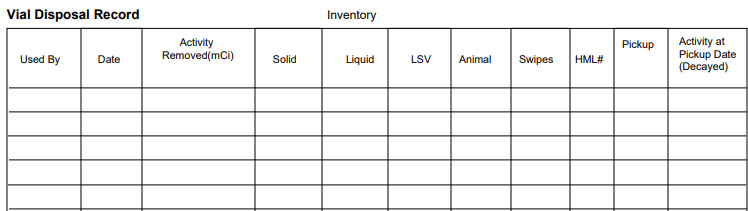
Per the Radiation Safety Manual, all PIs must maintain an accurate and current inventory of all radioactive materials from the point of receipt until final disposal. PIs may use various methods to document inventory such as a spreadsheet or the back of the package receipt form (as shown below). However, the final and current inventory must always be reflected in Environmental Health & Safety Assistant (EHSA). For instructions on how to use RAM, watch the Using and Tracking RAM video on the EHSA Tutorial page. You can log into EHSA using your MU Pawprint and associated password through the EHSA Login portal. EHSA allows users to keep a detailed inventory that will decay-correct each inventory to the exact time the data is accessed. Once the user moves inventory to a waste container, it is still considered part of the PI's inventory until EHS removes it from the lab. A detailed written tutorial on how to update inventory in EHSA including adding inventory to a waste container can be found on the New Ram Waste Container page.
HOW TO COMPLETE YOUR INVENTORY VERIFICATION REPORT
Inventory Verification reports cover half a calendar year, starting on January 1st through June 30th and July 1st through December 31st. These are used by EHS to verify receipt, transfers, disposals and decay of your radionuclides in order to meet our commitment of inventory control for the NRC. Your assigned Health Physicist will send you a copy of your inventory verification report to review twice a year as part of the semi-annual audits. Below are some of the areas in the report you should examine to ensure that our records match yours. The included pictures are for example only.
General information
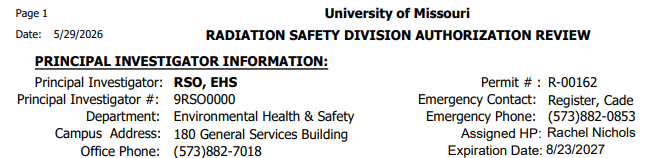
The general information includes the PI's name and campus address, PI's office phone number, permit expiration date, and assigned HP initials.
Authorized Nuclides & Quantities

This is the listing of approved radionuclides and possession limits, review that it is accurate.
Laboratory Personnel
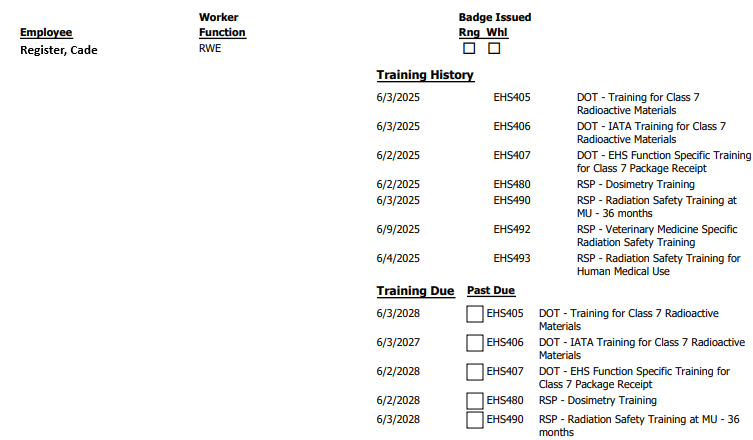
Review the Radiation Workers listed under your permit. Note any changes such as individuals no longer in your labs. Pay attention to their training records and follow up with individuals who are past due or due soon for training. The column titled "Worker Function" is an internal EHS label used to assign the training curriculum, so PIs should not need to review that. Additionally, the "Badge Issued" column is not used currently in EHSA and can be ignored. All Radiation Workers, Authorized Users, and the PI must be listed here!
Sealed Source Isotope List

The sealed source isotope list will show all sealed sources under the ram permit. The license line # column indicates under which part of Mizzou's NRC Radioactive Materials License the sealed source is regulated. The inventory # column is the inventory number for that individual sealed source as found in EHSA. The current activity column is the decay-corrected activity of the source decayed to the date the report was generated. The last leak test column is when EHS last performed a leak test; if the column is blank, then that source most likely is exempt from leak testing. The last inventory date column is when EHS last inventoried the sealed source. Review all information in this section and document any changes, making sure to confirm that all sealed sources in possession are listed.
Authorized Radioactive Material Lab Locations

Review the list of approved ram labs. Update the lab phone number if desired, although this information is not crucial. The inspected column is used internally for EHS purposes. The room type is a generic classification that assists EHS on which room types to inspect; verify the room types are appropriate. Sometimes, the room types will be special classifications (such as Modified Restricted Area) that have been approved by the Radiation Safety Committee.
Survey Meters

All survey meters that are actively used will be listed in this section along with the calibration date and location. Review and update this information as needed.
Inventory Verification
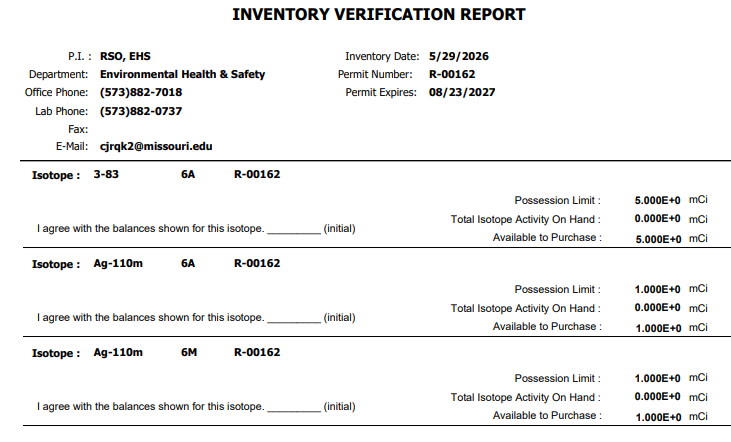
At the bottom of the report is the actual individualized inventory verification. Each approved radionuclide will have it's own section. If there is no inventory in EHSA for a specific radionuclide, then the section will look like the picture shown above. Confirm that you do not have any inventory of this radionuclide on hand and initial as such.
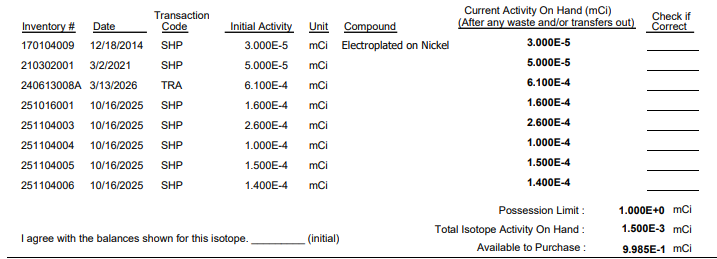
If you do have inventory on hand for a specific radionuclide, then each inventory number will be listed in the section for that radionuclide. Go through each inventory number, confirm it is still on hand, and verify the activity on the report matches any other records you may have; you can do this by using the "current activity on hand" column. If the activity is correct, write a check in the "check if correct" column. If there is a discrepancy, make a note next to the inventory line. Place your initials next to the initial box once you have reviewed that section. Note that sealed sources will show up in this section as well with their own line and inventory number!
Sign the Report

When you have reviewed the entire report and made appropriate annotations, sign and date the report at the bottom. A delegate may sign and date this section in place of the PI.
Final Step!
Once signed, do not forget to send a copy back to EHS. The inventory verification must be performed on a semi-annual basis. Failure to send the signed report back to EHS may result in violations on the PI's inspections or audits. Performing the inventory verification is a requirement by Mizzou's NRC Radioactive Materials License committments. When the assigned Health Physicist receives the annotated and signed copy, changes indicated on the report will be updated in EHSA with comments documented in the PI's audit. EHS does not require a hard copy of this signed report. You can send a copy of the signed report via email.
Page last updated on May 29, 2026..