Peroxide-forming chemicals (PFCs) require careful management throughout their lifecycle in the laboratory. Safe use depends on preventing peroxide buildup through proper purchasing, storage, inspection, testing, and disposal practices. Laboratories should manage these materials proactively to reduce the risk of dangerous peroxide formation and to ensure chemicals do not remain in service beyond safe time limits.
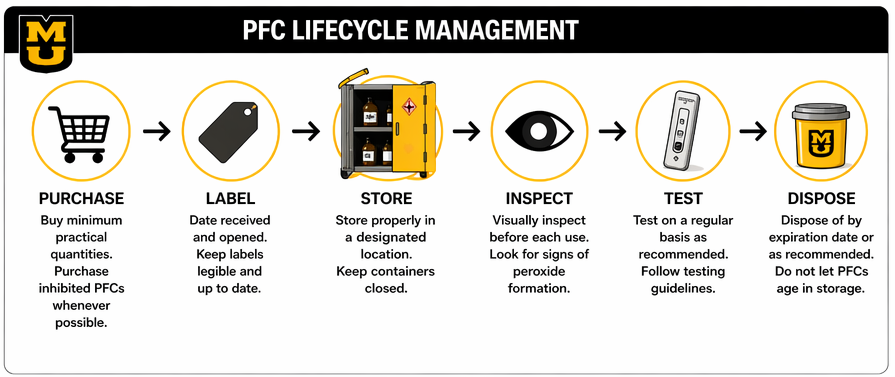
Labeling PFCs
Peroxide-forming chemicals must be clearly labeled so laboratories can track container age, inhibitor status, testing history, and disposal timeframes. A PFC label is required for any new or existing chemical that is known or suspected to form peroxides. Labels should be applied when a PFC is received, opened for the first time, transferred into a secondary container, dispensed from a solvent purification system or still, or identified during inventory review, inspection, or laboratory cleanup.
The label should include the date received, date opened, discard no later than date, PFC class, inhibited status, and peroxide test log information. Circle or mark the appropriate PFC class: A, B, C, or D. Visit the PFC Labeling Requirements webpage for label information.
Using PFCs
When working with peroxide-forming chemicals, laboratories should follow good inventory control and routine inspection practices.
- First in, first out: Use older chemicals before opening new containers.
- Complete a visual inspection before each use.
- Purchase only the minimum practical quantity so the material can be used within the manufacturer’s expiration date.
- Always purchase inhibited peroxide-forming chemicals unless the experiment will not tolerate the inhibitor.
- Dispensed solvents from laboratory purification systems do not contain inhibitors and can readily form organic peroxides. Best practices for using these solvents include:
- Do not dispense more than what will be used during the work period.
- Dispose of all unused solvent after dispensing.
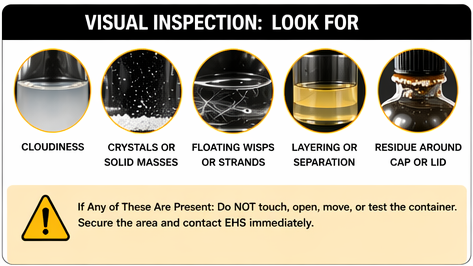
- Maintain vigilance for crystal formation, precipitates, or residues.
- Clean receiving containers thoroughly before reuse.
Storing PFCs
Peroxide-forming chemicals should be stored in a way that minimizes the chance of forgotten or aging containers.
- Designate a single storage location for all PFCs to avoid “forgetting one.”
- Follow all recommended storage guidelines for peroxide-forming chemicals.
- Keep containers closed when not in use.
- Store materials in appropriate conditions and away from incompatible hazards.
Testing PFCs
Routine testing is an important part of managing peroxide-forming chemicals safely.
- Test PFCs on a regular basis, as recommended by the manufacturer or by the University of Missouri testing guidance.
- Always perform a visual inspection before handling or testing.
- Never return decanted reagents to stock bottles.
- For PFC testing instructions and supplies visit the Testing Peroxide Forming Compounds EHS website.:
Maximum Retention Times
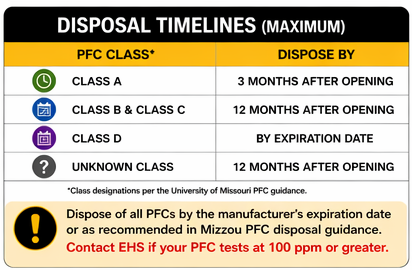
The maximum retention period depends on the PFC class, inhibitor status, date opened, and manufacturer’s expiration date.
- Inhibited Class B, C, and D PFCs must be used or submitted for disposal within 12 months after the container is first opened or by the manufacturer’s expiration date, whichever occurs first.
- Class A PFCs must be used or submitted for disposal within three months after opening or by the manufacturer’s expiration date, whichever occurs first.
- An inhibitor slows peroxide formation but does not eliminate the hazard. Inhibitor status does not allow a chemical to be retained beyond its applicable deadline.
Disposing of PFCs
Peroxide-forming chemicals should be disposed of before they become a greater hazard.
- Dispose of all PFCs by the manufacturer’s expiration date or as recommended in University of Missouri disposal guidance.
- Promptly dispose of expired or unneeded materials.
- Contact Environmental Health & Safety immediately if a PFC tests at 100 ppm or greater.
When to Contact EHS
Contact University of Missouri Environmental Health & Safety for assistance if:
- A peroxide-forming chemical tests at 100 ppm or greater
- Crystals, precipitates, cloudiness, or residues are observed
- A container appears old, damaged, or unsafe to open
- You need help with testing, storage, or disposal guidance
For assistance, contact University of Missouri Environmental Health & Safety at (573) 882-7018.